Email verification (DKIM keys)
Latest Salesforce email: Immediate Action Required: Verify Your Domains for Email Security (sent March 2, 2026)
What's happening?
Salesforce require verification for the sending of emails from most email domains. Systems won't deliver emails you send from unverified domains.
Will this affect you?
This change will impact you if you haven't enabled DKIM or authorized domains. This applies to any domains you use to send emails from within your org.
Sending email domains for common public email services, such as gmail.com and outlook.com, are exempt from the domain-level verification requirement. This change also has no impact on emails sent through Gmail and Office 365 (Outlook) integrations. Or emails you send via the Salesforce Einstein Activity Capture (EAC) tool.
Salesforce deploys this change in Spring ’26, patch 10, starting March 9, 2026. To determine the patch version for your org, go to Trust Status, search for your My Domain name or instance, and select your instance name.
New Sending Email Domains: New domains in existing orgs, and all domains in new orgs and new sandboxes, require immediate verification.
To verify the ownership of domains sending email, Sage People recommends enabling DKIM (Domain Key Identified Message) for your organization.
Recommended action
To check you can send emails from your Sage People org, we recommend completing the steps below.
Step 1 - enable Send Email for Users with unverified domains
We recommend enabling this option to ensure emails you send from unverified domains still deliver. This has no effect on emails you send from verified domains.
-
From Setup, in the Quick Find box, enter Deliverability and select Deliverability.
-
Select Use a substitute email address for unverified domains.
-
Choose the email you want substitute email to send from. Save your changes.
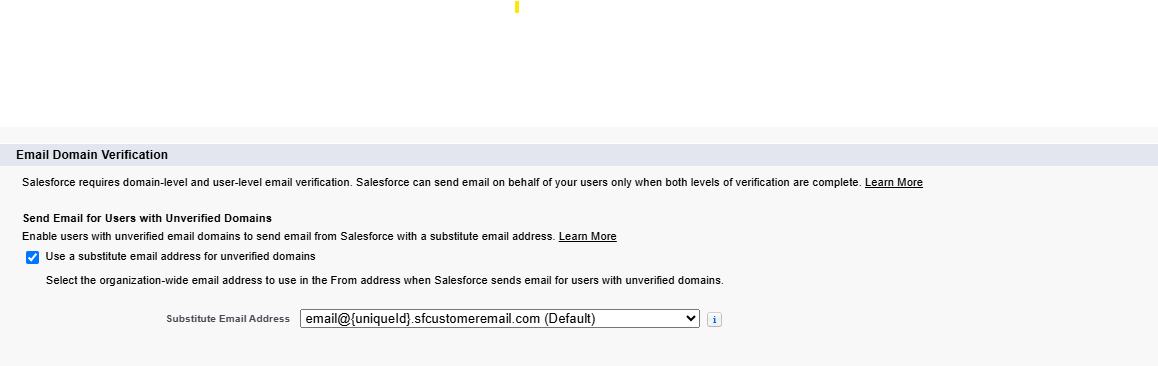
when users with an unverified email domain send emails from Salesforce, the From field can show either their Salesforce email address or the substitute email address.
For more information, see the Salesforce article Send email for users with unverified domains.
Step 2 - enable the verification bypass
-
From Setup, in the Quick Find box, enter Deliverability and select Deliverability.
-
On the Deliverability page, scroll to the Email Sending Domain Ownership section.
-
Select the checkbox Verify the ownership of email sending domains by DKIM keys.
If you don't want to enable DKIM or to select this option, ensure users sending emails from within Sage People have a verified email address.
-
In your Sage People org, go to Setup.
-
In Quick Find, enter users and select Users.
-
On the Users page, select the full name of the user you want to check.
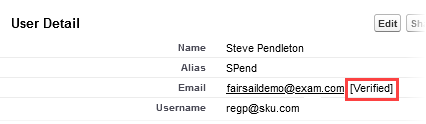
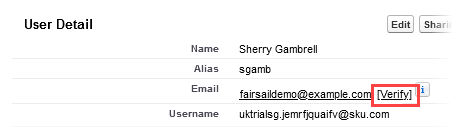
Next to the email address the page displays Verified or Verify:
-
To verify a user, select Verify.
The system sends an email verification request to the user.
-
On receipt, the user selects the link in the verification request email to verify their account.
For more details, see Email authentication for outgoing emails
For Salesforce help, see Verify Email Addresses to Meet the Email Verification Requirement.
Step 3 - verify your email-sending domains
You have two options to use to verify your email-sending domains. We recommend setting up a DKIM but you can choose to set up authorized email domains.
For more information, see the Salesforce article Verify your email-sending domains.
How do I check if my org has DKIM enabled?
-
Log in to your Sage People org and go to Setup.
-
In Quick Find, enter DKIM and select DKIM keys.
If you have a DKIM key listed with the Active checkbox selected, you have DKIM enabled.