PDF Templates | Create a Salesforce site to support PDFs
Understand how to create a Salesforce site in Sage People to support PDFs.
You need to create a Salesforce site to support PDFs that you:
-
Send as a result of an action event
OR
-
Include in a batch
OR
-
Send using the Send PDF button from a record, if greater than 4000 characters long
NoteUsing Preview on the Send PDF page to view a PDF before sending it can add invisible characters to the PDF. This increases the character count. You can push PDFs at or near the 4000 character limit over the limit. So they won't send if you don't have a supporting Site.
If you're not sure your PDFs will remain below 4000 characters, set up a supporting Site. This ensures you can send them.
Resolution
- Create a Salesforce site to support PDFs
- Configure Visualforce page access for the site
- Configure guest user access
- Register the site URL on the HCM Configure page
- Add a Remote Site for the site
Create a Salesforce site
The URL for your site is in the form: http://xxxx.my.salesforce-sites.com/yyyy
xxxx is your organization's My Domain subdomain and yyyy is the URL path for your site.
-
Go to the Sites setup page:
Go to Setup. In Quick Find, enter Sites.
-
Salesforce creates a site domain automatically using your organization's custom domain. If you haven't done so already, read and accept the Salesforce Sites Terms of Use. Select Register My Salesforce Site Domain.
- Select New.

-
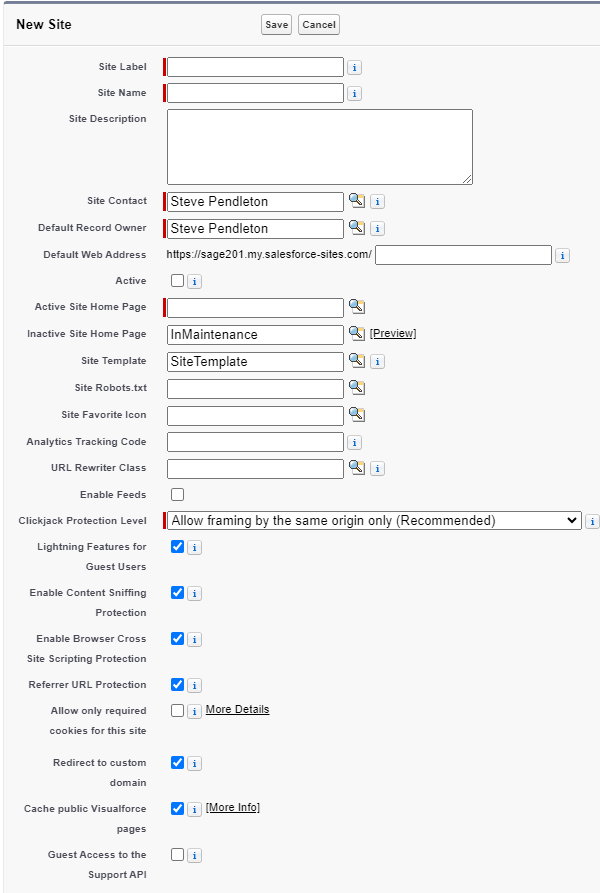
Salesforce displays the Site Edit page.
-
Give the site a Label and optional Description. The label generates the Name field automatically.
-
In the Default Web Address field, enter the URL path for the site. For example, pdf. This will be the public URL external users will use to access your site.
-
Mark the site as Active to make it available. If you're not ready to publish the site, you can edit the site later to make it active.
-
For the Active Site Home Page, select the Visualforce page for the site. Select Lookup
 and search for PDF. Use the default page unless you've created an alternative.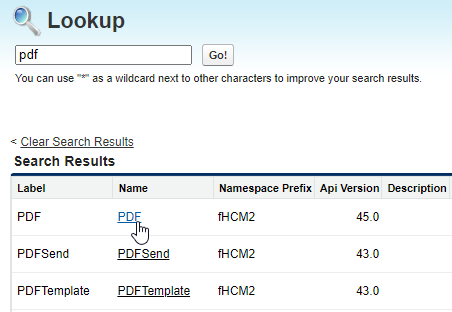
-
Leave the other fields set at their defaults unless you need to adjust advanced settings for the site.
-
Select Save.
Sage People displays the Site Details page for the new site.
Configure Visualforce page access
Next we must configure Visualforce page access to make site template pages accessible through this site.
On the Site Details page for the new site:
-
Scroll down to the Site Visualforce Pages Related List and select Edit.
-
On the Enable Visualforce Page Access page, select the following pages from the list of Available Visualforce Pages. Add them to the list of Enabled Visualforce Pages:
- fHCM2 FormPDF
- fHCM2 PDF Send
- fHCM2 PDF Template
- fHCM2 PDF TemplateEdit
-
Select Save.
The list of Site Visualforce Pages includes some default pages to handle standard conditions. These are in addition to the PDF-specific pages you added.
Configure guest user access
Next, configure public access settings to allow guest users to access this site.
On the Site Details page for the new site:
-
On the Site Details page, select Public Access Settings.
Sage People displays the Profile page created for the site you defined. The system assigns the Profile to a Guest User License.
-
On the Profile page, select Edit.Sage People displays the Profile Edit page.
-
Scroll down to the Custom Object Permissions section, and set the following permissions.
Custom object Permissions to grant Read
Create
Edit
Delete
View All
Modify All
Employment History
Yes
None
None
None
None
None
PDF Templates
Yes
Yes
None None None None PDF Template Sections
Yes
Yes
None None None None Team Member
Yes
None
None
None
None
None
-
Select Save.
Register the site URL
Next, register the site URL on the HCM Configure page. This is to associate the site you created with your HCM organization's Send PDF function.
-
Go to Setup. In Quick Find, enter Installed, and select Installed Packages from the search results.
-
Beside the Human Capital Management package, select Configure.
Sage People displays the HCM Configure page.
-
In the Sites URL field, enter the complete URL for the PDF site in the form:
http://xxxx.my.salesforce-sites.com/yyyy
where:
-
xxxx is your company identifier
-
yyyy is the site suffix. This is the part of the Default Web Address you entered when completing the Site Edit page at the start of this procedure
Ensure you specify the correct protocol - http or https - in the URL. Your organization's main site and this remote site must use the same protocol.
The Site URL on the HCM Configure page must exactly match the Remote Site URL in the Remote Site Settings.
-
-
Select Save.
Add a Remote Site
Finally, add Remote Site settings for the site you created to allow your Salesforce organization to call the external site.
-
Go to Setup. In Quick Find, enter Remote, and select Remote Site Settings from the search results.
-
On the All Remote Sites page, select New Remote Site.
Sage People displays the Remote Site Edit page:
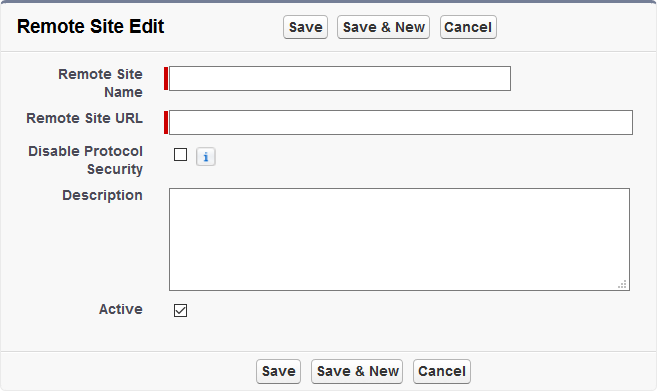
- Complete the fields as follows:
Field Description Remote Site Name
The name you want to display for the Remote Site. Enter a name that makes the site's function easy to identify. For example, PDF.
Remote Site URL
The URL for the Salesforce site you defined at the start of this procedure, without the suffix. For example, if the complete URL is:
https://xxxx.my.salesforce-sites.com/yyyy
enter:
https://xxxx.my.salesforce-sites.com
Ensure you specify the correct protocol - http or https. The protocol for the remote site must correspond with that for your organization's main site.
Make sure the Remote Site URL is exactly the same as the Site URL on the HCM Configure page.
Disable Protocol Security
Checkbox. Check to enable the Remote Site you'll use for both HTTP and HTTPS sessions.
Description
A brief description of the site's function to ease identification. For example, Supports Sage People Action Event PDFs.
Active
Checkbox. Select to activate the Remote Site.
-
Select Save.
You've now set up your org to let you send PDFs. Do this from Action Events, through batches, and by using the Send PDF button on a record. This applies when the PDF is greater than 4000 characters long.