Discover how to create an action event in Sage People.
-
In the HR Manager portal, select the Action Event Patterns tab. Select a view showing the action event pattern you want to extend with a new action event.
-
Select the Action Event Pattern name:
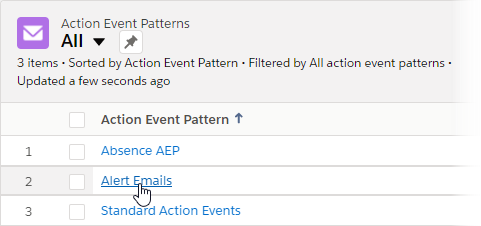
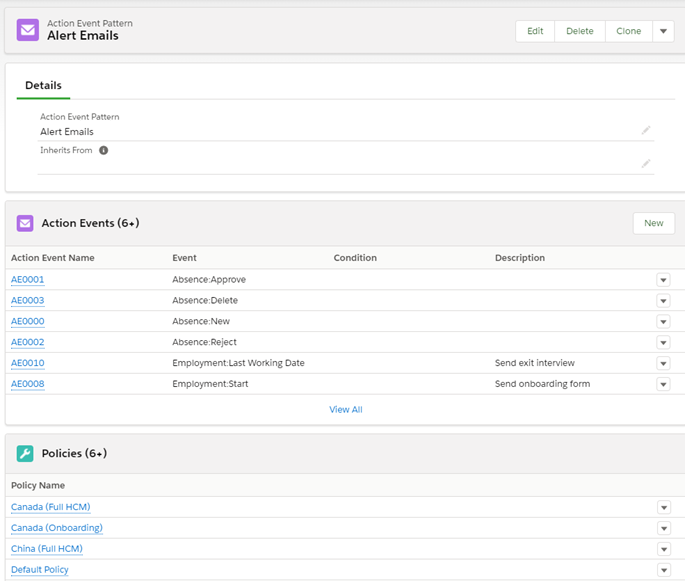
Sage People displays the Action Event Pattern Detail page:
-
In the Action Events section, select New.
Sage People displays the Action Event page:
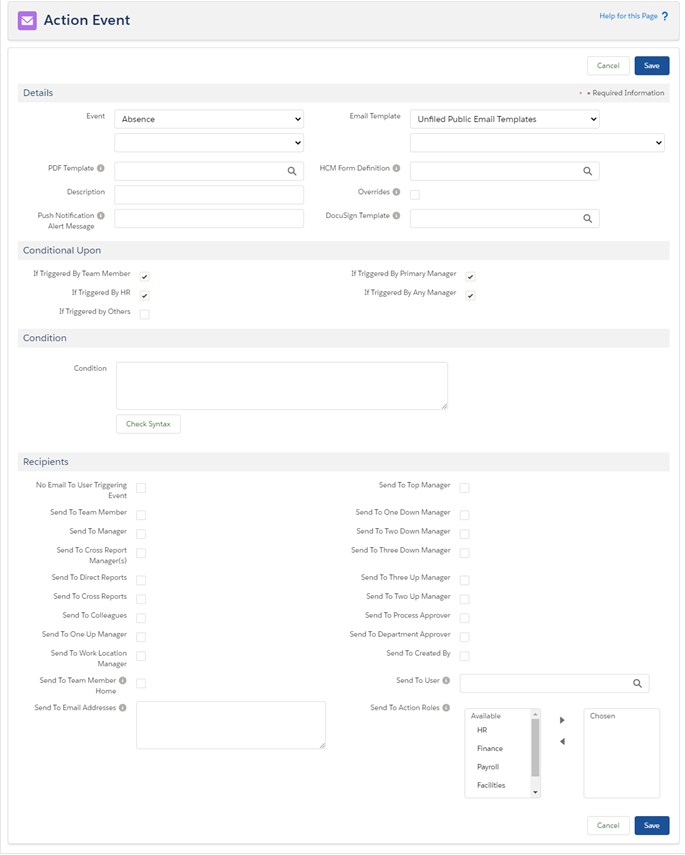
This page lets you define for each action event:
-
The trigger event
-
The conditions you want to meet for the event to send
-
Who is to receive it
-
-
Select the process and event you want to act as a trigger for this action event.
The first picklist includes the Sage People HCM processes your organization is using:
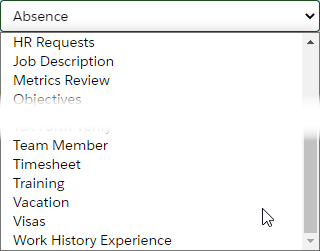
By selecting Benefits, Bonus or Salary you can link action events to HRIS processes, such as bonus awards or salary increases.
In the first Event picklist, select the process you want to use to trigger the action event. The second picklist displays the available events for the process you select in the first picklist. For example:
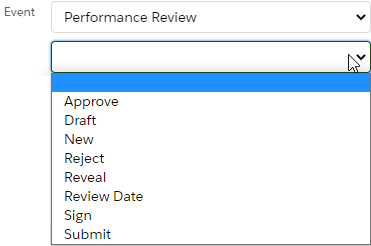
In the second Event picklist, select the type of event to trigger this action event.
NoteDon't leave the trigger event picklist field blank. If you do, the system won't identify a trigger event and the action event can't work.
When you select Employment in the first picklist and a date event in the second, Sage People displays two more picklists to specify an offset:

The offset is a number of days or months relative to the Employment date you select:
-
A positive offset is for a number of days or months after the date. The system assumes unsigned offsets as positive
-
A negative offset is for a number of days or months before the date. For example:
-
Employment Start Date set to October 6
-
Offset set to -10 Days (a negative offset of 10 days)
The event triggers on September 26, 10 days before October 6
-
-
A zero offset is on the date
In Offset enter the Offset value.
Select the picklist and select Days or Months.
When changing Employment Record dates be aware. Moving a date so that an associated trigger date is before today, means the action event will never trigger. For example, for an action event with an Offset of -10 Days, if:
-
Today is September 24
-
Employment Start Date changes from October 6 to September 29
The event won't trigger because the trigger date moves to September 19, before today.
Action events you trigger by Employment Record date events execute as part of the action events daily batch. Or, if you haven't set the batch, as part of the Sage People Digest daily batch. Therefore, the Sage People Digest must be active for the action events to execute.
-
-
Complete the other fields in the Details section as follows:
Field Description Email Template Picklists. The template group and email template for this action event. The email template must exist before you can link it to an action event. You can't create it from this page.
Select the first picklist and choose the email template group. The second picklist displays the email templates available in the group you selected.
Select the second picklist and choose the email template you want to use for this action event.
PDF Template An existing PDF template that you want to use to create a PDF file to send with the action event. Create the template with the Sage People PDF template generator. Make sure you base the formulas in the PDF on the object generating the action event.
PDF files up to 3MB in size send as attachments. Larger files convert to HTML links for download and remain available for 30 days.
A copy of the PDF stores as an attachment to the object creating the action event.
Select PDF Template lookup
 to find and select the template you want to use.
HCM Form Definition An existing form definition to use to create and send a form when this action event triggers. You can:
-
Send a form on its own
-
Send a form with an email the system bases on a template selected in the email template. A link to the form replaces the {!formurl} formula in the email template you select here
-
Use a form including form emails instead of or in addition to the action event. Action events have a wider range of recipients than form emails
If the form uses a linked object to pass back data, it must be the same type as the object triggering the action event. For example, if the event specifies a job description, the form definition you select here must also link to the job description. If necessary, create a new linked object relationship between the Form object and the Action Event object. This ensures the correct relationship exists.
Select HCM Form Definition lookup
to find and select a form definition.Description Text. A brief description of the function of this action event.
Add the Description field as a column in the Action Events related list on the Action Event Pattern detail page. This provides a useful summary of the action events in this pattern.
Overrides Checkbox. Applies to action events in a pattern set up to inherit action events from a parent pattern.
If you check this, the settings in this action event override those inherited from the parent action event pattern. It does this for all action events with the same trigger event. For example, when you check Overrides, the system changes how action events trigger. It removes three action events created by a new Absence event in the parent pattern. Then it creates one action event for the new Absence event in the child pattern.
If you don't check this, the settings in this action event don't override those inherited from the parent action event pattern. This applies to any action event with the same trigger event. The system preserves all inherited action events for the same trigger event. This action event operates in addition.
Push Notification Alert Message Text. Enter the text you want to use as the alert message for a push notification to Sage People Mobile. Typically a merge field you'll use to return a value from the Team Member or Employment Record objects. DocuSign Template An existing DocuSign template you want to use to create the send for eSignature message.
Select DocuSign Template Lookup
to find and select a template. -
-
Complete the fields in the Conditional Upon section as follows:
Field Description If Triggered By Team Member Checkbox. Select for the event to trigger when a team member acts on their own records in WX. For example, the team member requests an absence for themselves or reveals one of their objectives.
If the team member has a user they've delegated, the delegate's action on the team member's records also triggers the event.
If Triggered By Primary Manager Checkbox. Select for the event to trigger when a team member's manager acts on the team member's records in WX. For example, a manager approves an absence for the team member or reveals their performance review of the team member.
If the manager has a user they've delegated, then the delegate's action on the team member's records also triggers the event.
If Triggered By Any Manager Checkbox. Select for the event to trigger when a manager acts on the team member's records in WX. The manager can be a cross-reporting manager. They can also be a manager in the reporting line above the team member's primary manager. If Triggered by API User Checkbox. Select for the event to trigger when an API user performs an action. The system identifies an API user by having the Minimum Access - API Only Integrations profile. If Triggered By HR Checkbox. Select for the event to trigger when an HR Manager in the team member's HR Department acts on the team member's records in WX. If Triggered By Others Checkbox. Select for the event to trigger when a user acting isn't the team member themselves or the team member's manager. (This includes managers in the scope of If Triggered By Primary Manager and If Triggered By Any Manager). For example, a colleague completes a feedback request about the team member.
If Triggered By Others also includes actions in WX taken by users without related team member records.
Condition Formula. Use Condition for more complex conditions to meet to activate the action event.
If Condition includes a text string, for example a picklist value, with any of the characters:
&
<
>
enclose the complete string in opening and closing braces ( ) and precede it with escape
For example:
TEXT(fHCM2__Team_Member__c.Citizenship__c )= escape("Antigua & Barbuda")Condition supports a range of functions and operators.
An invalid condition generates an error message when you select Save.
TipYou can use Condition to ensure events only trigger for active employees and not to leavers. Do this by adding a condition you base on the Has Left field or the values used for Employment Status. Doing this stops the system triggering and sending emails for leavers.
-
Complete the fields in the Recipients section as follows:
Field Description No Email To User Triggering Event Checkbox.
Check if the user triggering the event is in a selected recipient group and you don't want them to receive the email.
Send To... Checkboxes. The people you want to receive this action event. Checkboxes include:
-
Send To Process Approver
Sends an action event email to the user you named in the Approver field: field name Approver__c, data type Lookup (Team Member). If you select Send To Process Approver and don't fill the Approver field, the action event sends the email to the team member's manager.
-
Send To Department Approver
Each HR Department can have a default approver for processes associated with their departments.
The remaining checkbox labels are self explanatory.
Check the boxes applying to this action event.
Sent To Action Roles Multi-select picklist.
Each action event can send to one or more action roles. You can assign Roles to HR departments and work locations, ensuring that nominated recipients receive matching Action Events.
Define your own action roles to match your needs. Ensure you add role names to:
-
The Send To Action Roles picklist on the Action Event object
-
The Role picklist on the Action Role object
Each role name in one picklist must have an identical match with a role name in the other picklist. Mismatched spelling is a common cause of error. Role names must be identical in both pick lists for the system to send action events to action roles.
Send To User A named Sage People HCM user to receive this action event.
Select Send To User lookup
to find and select the user.Send To Email Addresses Other direct email addresses you want to receive this action event.
Separate multiple email addresses with commas or by entering each email address on a new line.
-
-
Click Save.
Sage People displays the Action Event Pattern detail page with the new action event added to the list of events.